
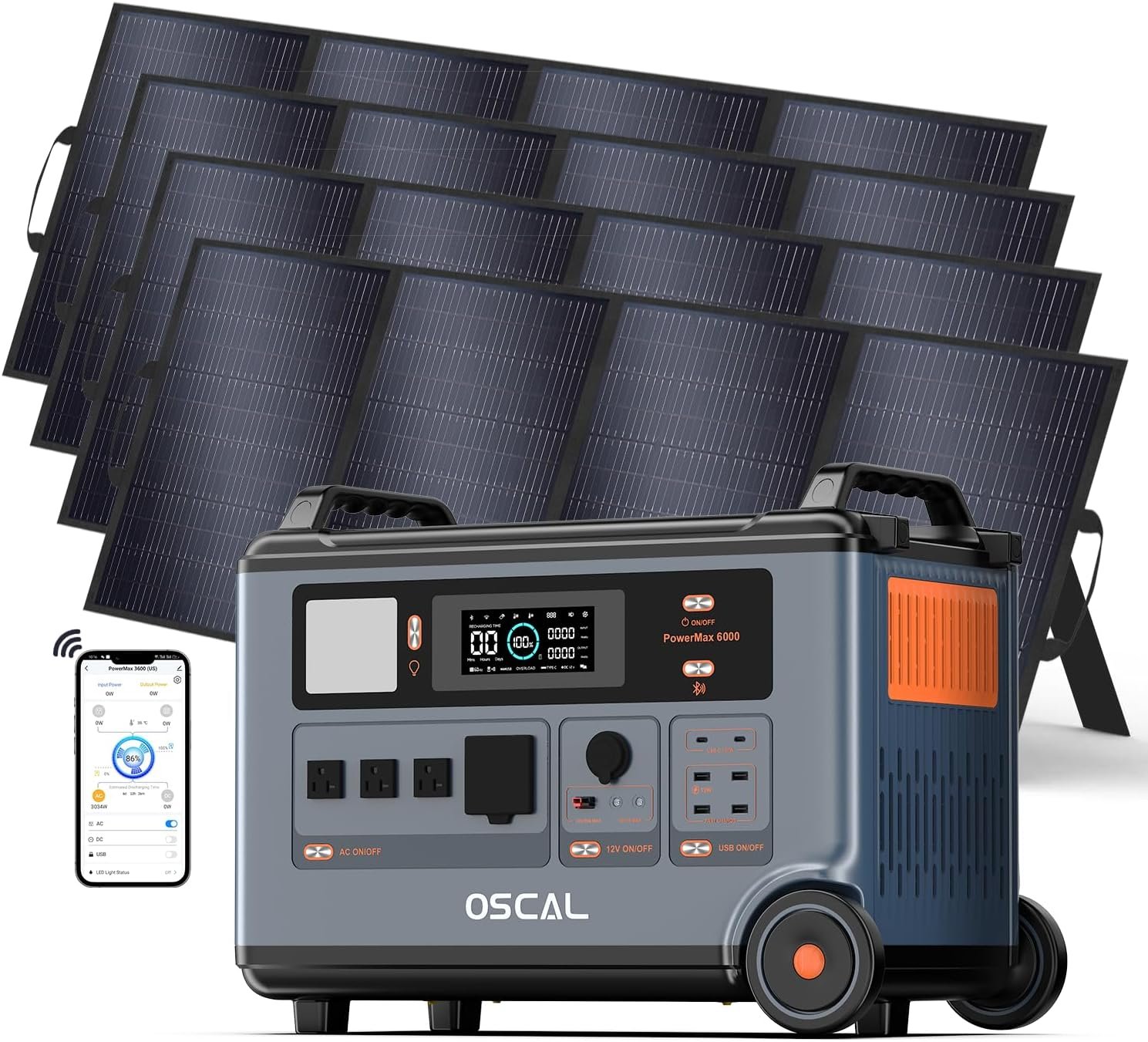
OSCAL PowerMax 6000 Solar Generator review
Thinking about a powerful solar generator that can handle home emergencies, outdoor work, and fast recharging?

OSCAL PowerMax 6000 Solar Generator with 3×400W Solar Panel — Quick Product Overview
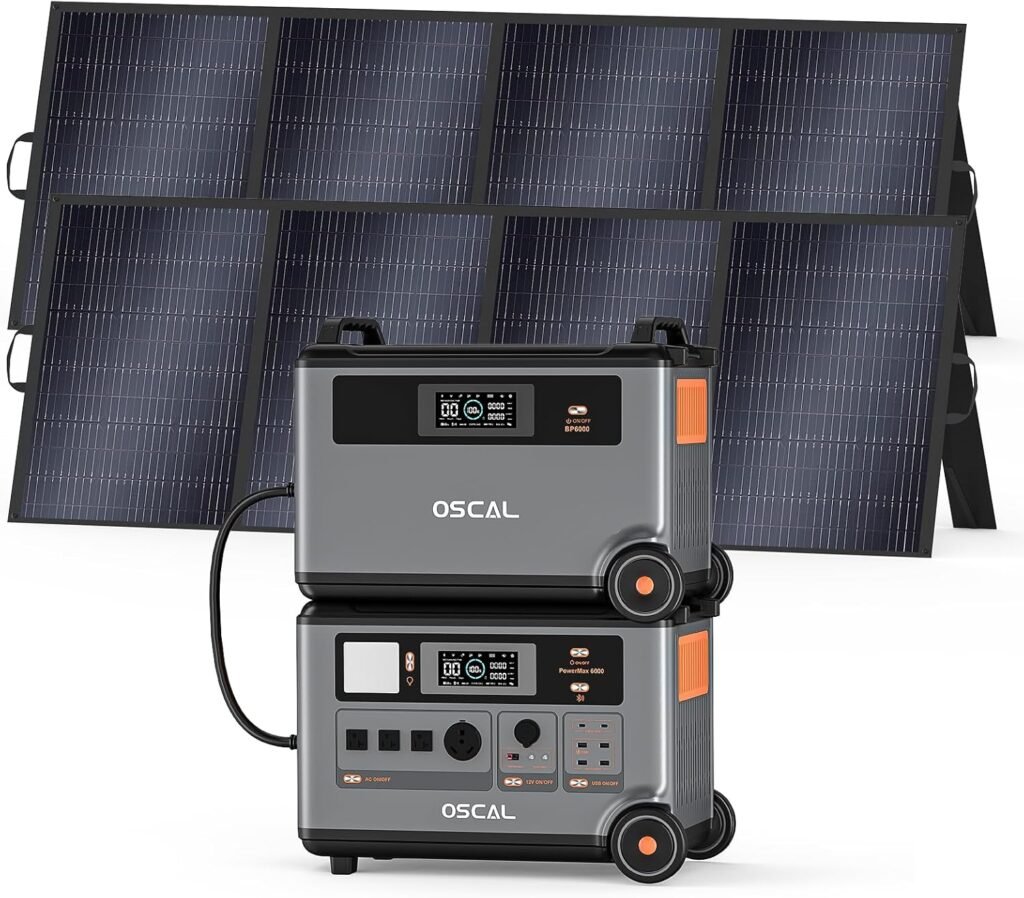
You’re looking at a heavy-duty portable power station that aims to serve as a true emergency backup and a versatile outdoor power source. The OSCAL PowerMax 6000 combines a 3600Wh LiFePO4 battery, a bi-directional inverter with split-phase 120V/240V capability, and three 400W solar panels to give you fast charging and flexible output options. If you want a generator that supports both household circuits and high-demand appliances, this one is designed to meet those needs.
Key Specifications (At a Glance)
Below is a clear breakdown so you can quickly compare the most relevant specs when deciding whether this unit fits your needs.
| Feature | Specification |
|---|---|
| Battery Capacity | 3600Wh (LiFePO4) |
| Inverter Continuous Output | 6000W (Split Phase 120V/240V) |
| Inverter Peak/Surge | 9000W |
| AC Outlets | 4 AC outputs (multiple outlets total: 14 ports) |
| Bi-Directional Inverter | Yes |
| AC Charging Input | Up to 2200W |
| Solar Input | Up to 2400W (with supplied 3×400W panels) |
| AC + Solar Combined Fast Charge | As fast as ~1.44 hours (combined inputs) |
| AC-only Full Charge | Approximately 1.96 hours (product stated) |
| Battery Chemistry | LiFePO4 (long life, ~3500 cycles) |
| EPS / UPS Switchover | 5–8 ms |
| Protection | 8-layer BMS: overcharge, over-discharge, over-voltage, over-current, short-circuit, temperature |
| App Control | Yes (OSCAL App) |
| Warranty | 2 years |
| Included Accessories | 3×400W solar panels, AC charging cable, car charging cable, solar charging cable, user manual, warranty card |
Design and Build Quality
You’ll notice the PowerMax 6000 has a rugged look that suggests durability. The housing is designed for frequent handling, and the unit includes handles and features geared toward portability for its class. Its materials and finish are made to withstand typical outdoor and indoor emergency conditions, though it’s still advisable to avoid prolonged exposure to rain unless you use additional protection.
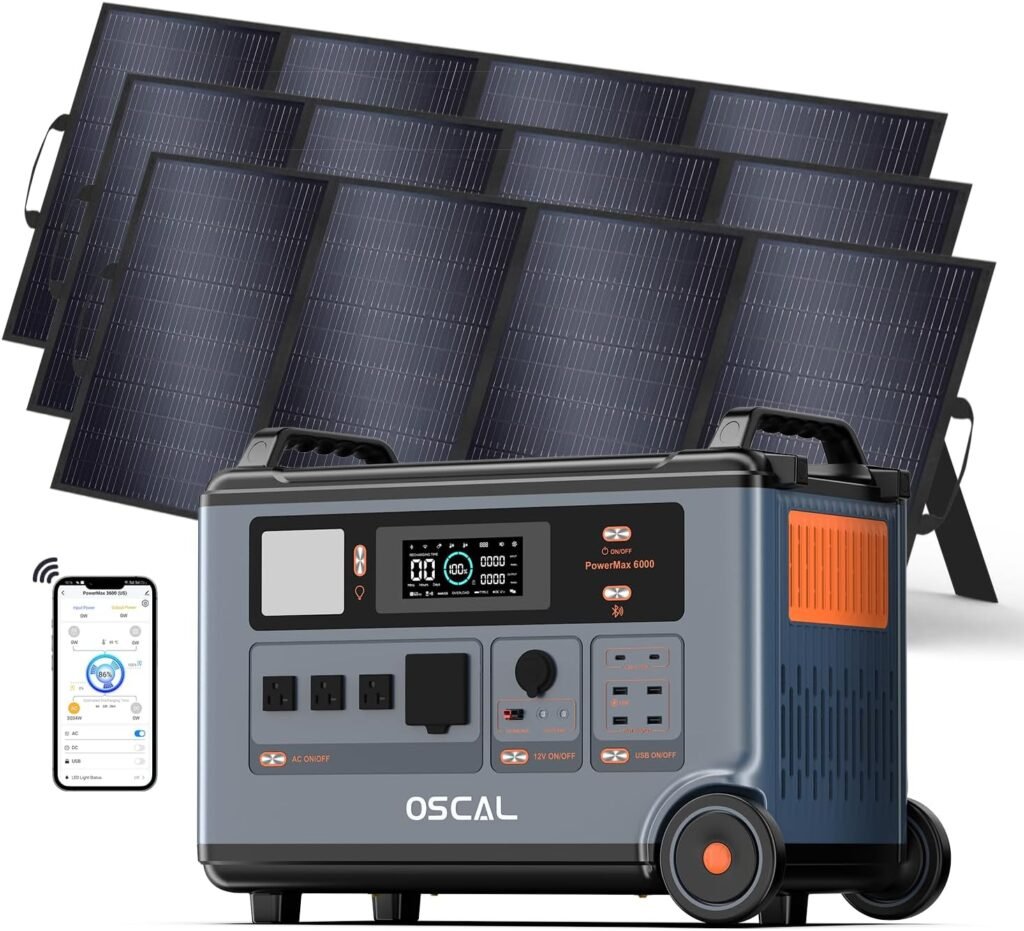
The three 400W solar panels are foldable and framed to be portable while maximizing power output. Expect a balance between sturdiness and manageability; the panels are heavy during transport but fold down for storage.
Portability and Weight Considerations
Because this is a high-capacity 3600Wh unit with a large inverter and LiFePO4 cells, it’s not as light as smaller power stations. If you plan to move it frequently by yourself, consider the weight and whether a cart or dolly would help. For stationary emergency backup at home or for RV setups where it stays in place most of the time, you’ll appreciate its power density.
If you often need to move the unit between job sites or campsites, practice a safe lifting technique and consider assistance. The included solar panels are easier to carry individually but will add to the total load you transport.
Battery Technology and Lifespan
You’ll get the LiFePO4 chemistry, which is one of the main selling points. LiFePO4 cells give you high cycle life, thermal stability, and a safer chemistry compared to many other lithium-ion variants. OSCAL claims up to 3500 charge/discharge cycles, translating to a potential service life of up to 25 years depending on usage patterns and storage conditions.
The 8-layer BMS provides several protections to safeguard the battery and connected equipment. This includes protections for overcharge, over-discharge, over-voltage, over-current, short-circuit, and temperature variations. For you, that means more peace of mind when running sensitive electronics or leaving the unit unattended during charging.
What the Cycle Count Means for Your Use
Because LiFePO4 is built for longevity, you don’t need to baby the unit for it to last. If you use the pack daily, you’ll still get many years of service. If you’re using it sparingly for emergency backup, it could last decades. Store it at a partial state of charge in moderate temperatures to preserve battery health when it’s not in active use.
Charging Options and Performance
You have multiple fast charging choices. The unit supports a maximum AC charging input of 2200W and a solar input of up to 2400W. With the three included 400W solar panels you can approach the 2400W input under ideal sun conditions.
OSCAL lists two important charging timelines: full charge as fast as 1.44 hours when you combine 2200W AC and 2400W solar, and approximately 1.96 hours for a full charge under AC-only at top input. In practice, combined charging yields the fastest recharge, while solar-only charging time varies based on sunlight, angle, shading, and weather.
Real-World Charging Notes
You should expect the following in practical scenarios:
- AC-only high-power charging will get you a full cycle in under 2 hours usually, provided you can supply the unit with the required 2200W AC input.
- Solar-only charging depends on peak sun; in ideal peak sunlight you can get close to full charge in about 1.5 hours (3600Wh ÷ 2400W ≈ 1.5h).
- Combining AC and solar is handy when you want to top up quickly or during sustained outages when sunlight is available during the day.
Keep in mind solar production drops with cloud cover and lower sun angles. Using the supplied panels at the best angle and avoiding shade will make a big difference to your actual solar charging time.
Output Capabilities and Load Handling
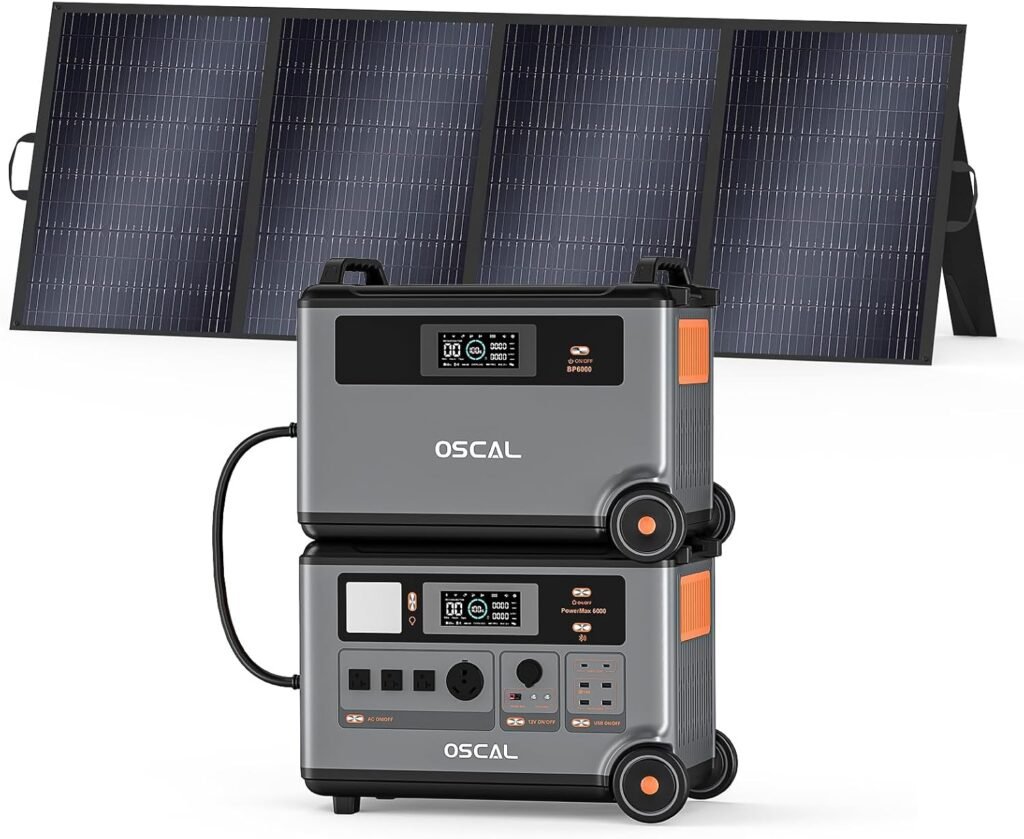
You can power most household appliances and even heavier equipment thanks to 6000W continuous output and a 9000W surge capacity. That means you can run large loads such as pumps, some electric ranges (depending on startup demands), multiple appliances simultaneously, and power tools. The unit has multiple outlet types and a total of 14 connection points to keep many devices running at once.
The split-phase 120V/240V capability is especially valuable if you want to run 240V appliances or set up a temporary split-phase household backup with appropriate transfer equipment and electrician work.
Using the Split-Phase Feature Safely
If you plan to use the split-phase to replace household service, consult a licensed electrician and use a proper transfer switch. You should not connect the unit directly to household wiring without the correct interlock and safety measures. With correct installation, you can power critical circuits or even larger loads that require 240V.
Fast Switchover for Critical Loads
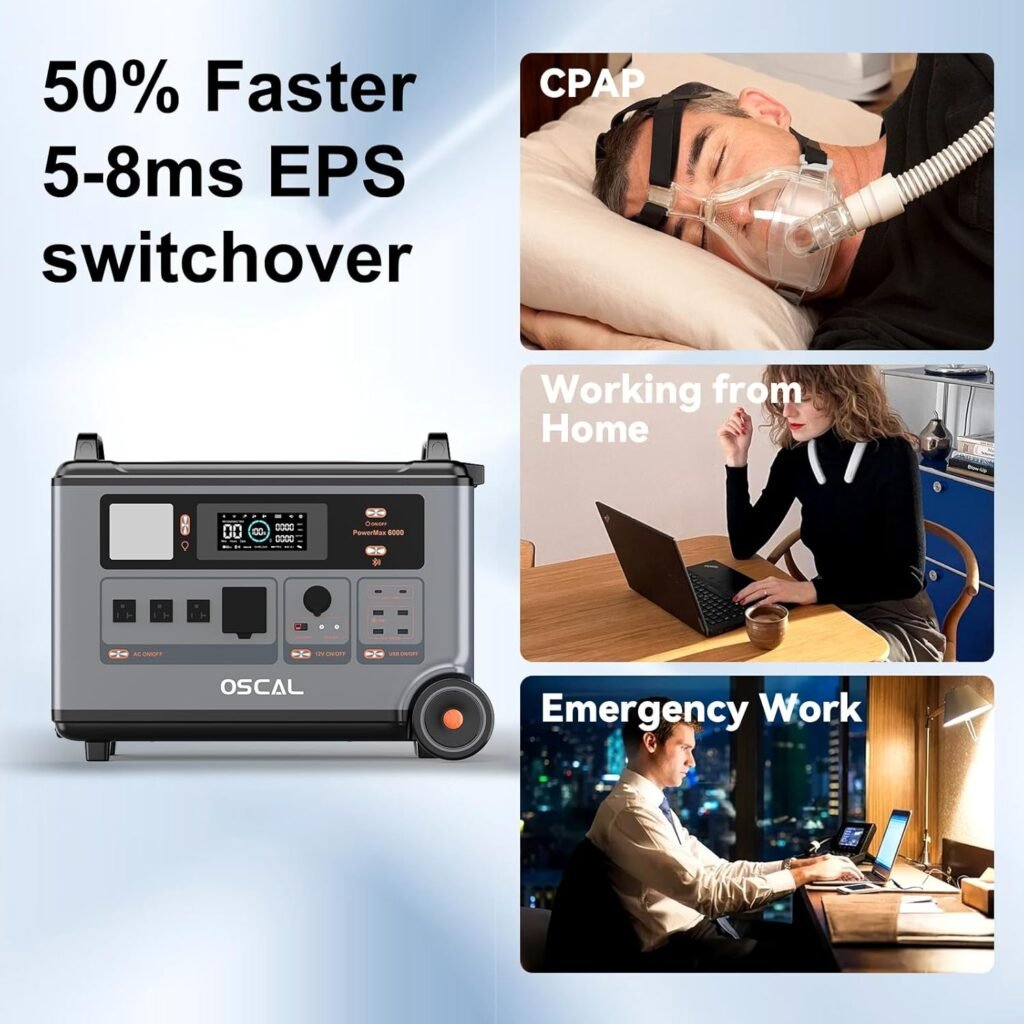
The EPS feature has a switchover of 5–8 ms, which is fast enough for most home electronics and networking gear. That will keep your routers, modems, and many sensitive devices running without shutting down, though some highly sensitive industrial equipment might still require an online UPS with zero transfer time. For most home emergency uses, 5–8 ms is acceptable.
Solar Panels and Integration
You get three 400W panels with the package, totaling 1200W nominal panel wattage by model but with actual maximum solar input supported up to 2400W. This likely implies the panels can be used in configurations to optimize MPPT input and match voltage/current requirements; the manufacturer has provisioned a solar input capacity that exceeds the nominal sum so you can take advantage of strong solar conditions or add more panels if the system supports it.
Be mindful of panel placement: keep them free from shade, oriented correctly, and cleaned periodically. Angle the panels toward the equator and adjust seasonally if you plan long-term installation to maximize daily yield.
Solar Panel Setup Tips
- Use a rigid flat area or panel stands to avoid panels tipping in wind.
- Avoid partial shade on any panel in a series string, as that will disproportionately reduce output.
- Keep a safe distance between panels and hot surfaces; panels perform less efficiently when very hot.
App Control and Monitoring
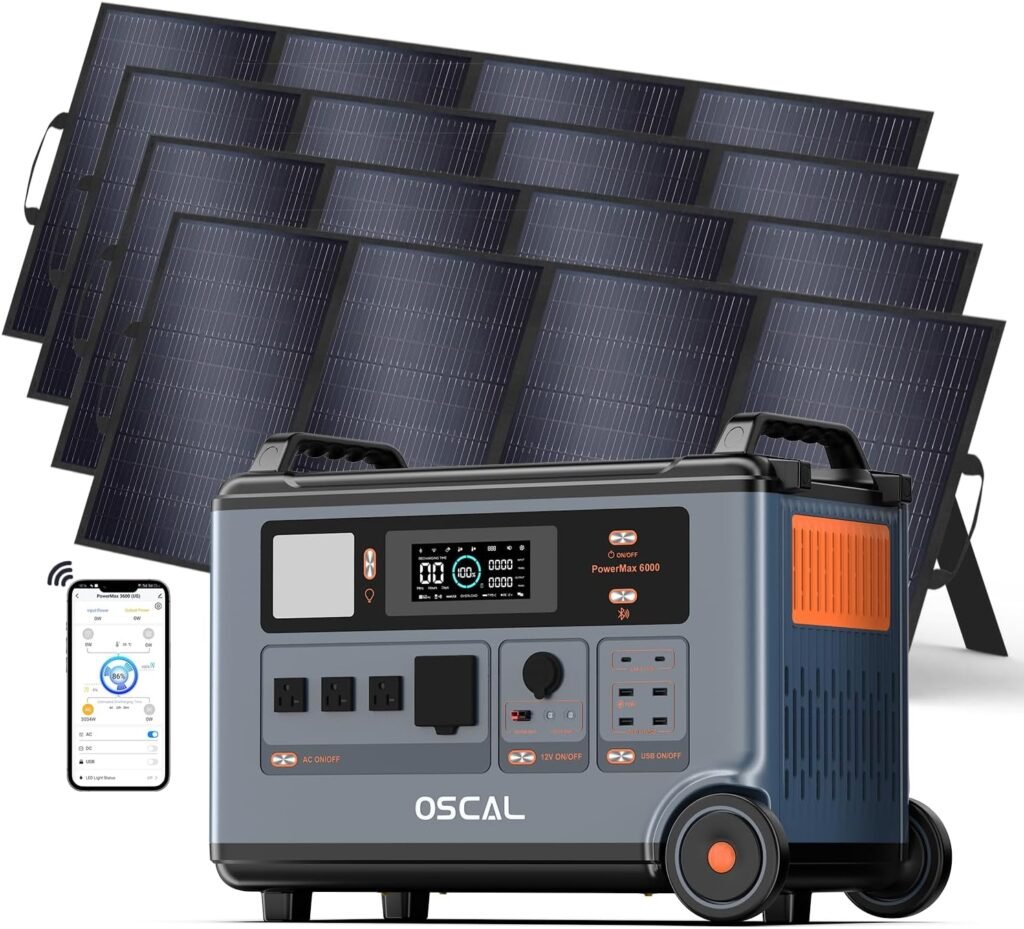
You can download the OSCAL app to pair with the PowerMax 6000. The app gives you remote monitoring and control of the station, allowing you to check battery state, input/output power, and execute certain commands. For you, that means easier management of charging schedules and monitoring during extended outages without needing to be physically next to the unit.
The app can be handy for troubleshooting and confirming that solar input and AC charging are performing as expected. Make sure to keep firmware updated through the app if updates are offered to improve performance or compatibility.
What You Can Manage from the App
You’ll typically be able to:
- See real-time battery percentage and estimated runtime.
- Monitor AC and solar input/output power numbers.
- Turn on/off certain outputs remotely if supported.
- Receive alerts or error messages if the system detects an issue.
Safety, BMS, and Reliability Features
OSCAL has included an 8-layer BMS to protect the battery and connected devices. That means multiple safeguards against overcharging, deep discharge, over-current events, short-circuits, and temperature excursions. The LiFePO4 chemistry itself reduces thermal runaway risk compared to other lithium chemistries.
The 3500-cycle claim points to a battery designed for long-term use. Given proper care—proper storage charge level, moderate temperatures, and avoiding extreme discharge—you’ll get consistent performance for years.
Recommended Safety Practices
- Keep the unit out of direct rain unless properly sheltered.
- Use the provided cabling or manufacturer-approved alternatives.
- Prevent overloading the unit beyond 6000W continuous or 9000W surge.
- Do not attempt to service the battery yourself; refer servicing to qualified personnel.
Typical Use Cases and Scenarios
You’ll find the PowerMax 6000 useful across multiple scenarios:
- Home emergency backup: Keep refrigerators, sump pumps, medical devices, and communication gear running during outages.
- Whole-house partial support: With split-phase and proper installation, you can power significant household loads for hours.
- RV and van life: Use it for air conditioning (depending on draw), microwaves, and charging appliances while on the road.
- Outdoor work sites: Power power tools, lights, and laptops without running noisy gas generators.
- Events and production: Provide reliable, quiet power for AV equipment, lighting, and staging.
The flexibility of AC, DC, solar, and car inputs makes the unit suitable for many environments and tasks. You decide which mode suits your needs in the moment.
Example Load Estimates
Here are approximate runtimes for typical loads to help you plan usage (actual runtimes will vary based on efficiency, environmental conditions, and load characteristics):
- Refrigerator (150–200W average): ~18–24 hours
- Chest freezer (100W average): ~30–36 hours
- Sump pump (large intermittent draw): runtime depends on cycles; can handle startup surge
- Microwave (1000W): ~3–4 cycles of a few minutes each
- Power tools (1500–3000W intermittent): can support many tools depending on duty cycle
- Small window AC (800–1200W): several hours depending on duty cycle
Setup and Installation Advice
When you unbox the unit, place it on a stable, level surface and run through the included manual. If you plan to use the split-phase or connect to home wiring, hire a licensed electrician to install a transfer switch or interlock kit. For solar setup, lay out the panels to avoid shading and use proper panel connectors and MC4 cables as required.
If you plan to use the generator indoors, ensure adequate ventilation and keep the unit away from combustible materials. While LiFePO4 is safer than some other chemistries, you should still follow the manufacturer’s guidelines for safe operation.
First-Time Setup Checklist
- Inspect the unit and accessories for shipping damage.
- Fully charge the unit before first extended use to ensure calibration.
- Download the OSCAL app and pair it to your unit for easier monitoring.
- Test a few typical loads to understand real-world runtimes.
- If connecting to home wiring, arrange a professional transfer switch installation.
Maintenance and Care
You should perform minimal maintenance if you use and store the unit properly. Regularly clean the solar panel glass and keep connectors free of corrosion. Store the battery at a partial state of charge (around 40–60%) if you won’t use it for an extended period. Keep firmware updated through the app to benefit from improvements and fixes.
Check the physical condition occasionally for loose connections, fraying of cables, or panel hinge wear. Replace worn cables and store the kit in a cool, dry place when not in use.
Seasonal Storage Tips
- Store in a cool, dry environment.
- Keep the battery at partial charge and recharge every few months if stored long-term.
- Remove panels and store them folded to protect the surface and hinges.
Pros and Cons
You’ll appreciate certain clear strengths and need to be mindful of a few trade-offs.
Pros:
- High continuous output (6000W) and strong surge capacity (9000W) for heavy loads.
- Rapid charging with 2200W AC input and up to 2400W solar input.
- Long-life LiFePO4 battery with high cycle count and strong safety characteristics.
- Split-phase 120V/240V output for versatile household and appliance support.
- Fast EPS switchover (5–8 ms) suitable for most critical electronics.
- Includes three 400W solar panels for immediate solar capability.
- App control for remote monitoring and management.
Cons:
- Heavy and less portable compared to smaller-capacity stations.
- Solar charging is weather-dependent; real-world solar performance varies.
- If you plan a permanent home installation, you’ll need professional electrical work.
- The 14 total outlet ports are useful but could encourage overloading unless you monitor total draw.
- Warranty is 2 years—good but premium products sometimes offer longer terms.
Comparison Notes: Where It Fits Relative to Alternatives
If you’re comparing the PowerMax 6000 to other brands, focus on these differentiators: LiFePO4 chemistry, split-phase capability, and very high combined charging power. Many competitors offer lower continuous power or slower charging, while some match the chemistry but not the split-phase or the surge capabilities.
For you, this unit is strongest when you need robust surge handling, the ability to support 240V loads, and a fast recharge cadence that lets you cycle the battery quickly between uses.
Frequently Asked Questions (FAQ)
Q: How long will the battery last with daily use? A: With LiFePO4 and the stated 3500 cycles, daily shallow cycles could still give you many years of service. Exact years depend on Depth of Discharge (DoD) and environmental conditions, but the chemistry is chosen for longevity.
Q: Can I connect this directly to my home panel? A: Not directly. You need a proper transfer switch and a certified electrician to integrate it safely into home wiring.
Q: What if the solar panels are shaded? A: Partial shading significantly reduces output. For best results, place panels where they receive full sun, and avoid series connections that create bottlenecks if one panel is shaded.
Q: Can the unit run an electric oven or central A/C? A: It depends on the appliance’s startup and continuous draw. Central A/C often has very high startup currents. The unit’s 9000W surge can handle many startups, but runtime may be limited. Consult appliance specs and possibly use the unit for dedicated circuits instead of whole-house HVAC.
Q: Does the app allow firmware updates? A: Typically, yes. Use the OSCAL app to check for updates and keep your station current.
Final Recommendation and Buying Advice
If you want a high-capacity, fast-charging, and flexible power station that can genuinely support significant household loads during outages and also serve heavy-duty outdoor needs, the OSCAL PowerMax 6000 is a compelling option. You’ll benefit from LiFePO4 longevity, robust surge handling, split-phase support, and very fast recharge times when you have access to both AC and solar inputs.
Before buying, consider how you’ll use the unit: if you plan frequent transport, factor in weight; if you plan home integration, budget for professional installation. Also plan your solar panel placement to maximize the 2400W solar input. If your priority is raw power, fast recharge, and battery longevity, this unit is a very strong candidate.
If you decide to purchase, take time to read the manual, set up monitoring via the app, and arrange a professional for any installation that ties into household wiring. With sensible setup and care, this generator can be a long-term element of your emergency preparedness and off-grid toolkit.
Disclosure: As an Amazon Associate, I earn from qualifying purchases.