

PowerStationReviews · Gas Generator Buying Guide
Find a quieter generator for the power you actually need
The best quiet generators for camping and basic outage backup are often small inverter models. The Honda EU2200i is our first pick for light loads when noise matters most. The WEN 56235i is easier to lift, and the Champion 4500 gives you more power for an RV or several appliances.
As an Amazon Associate, I earn from qualifying purchases.
View the Amazon listing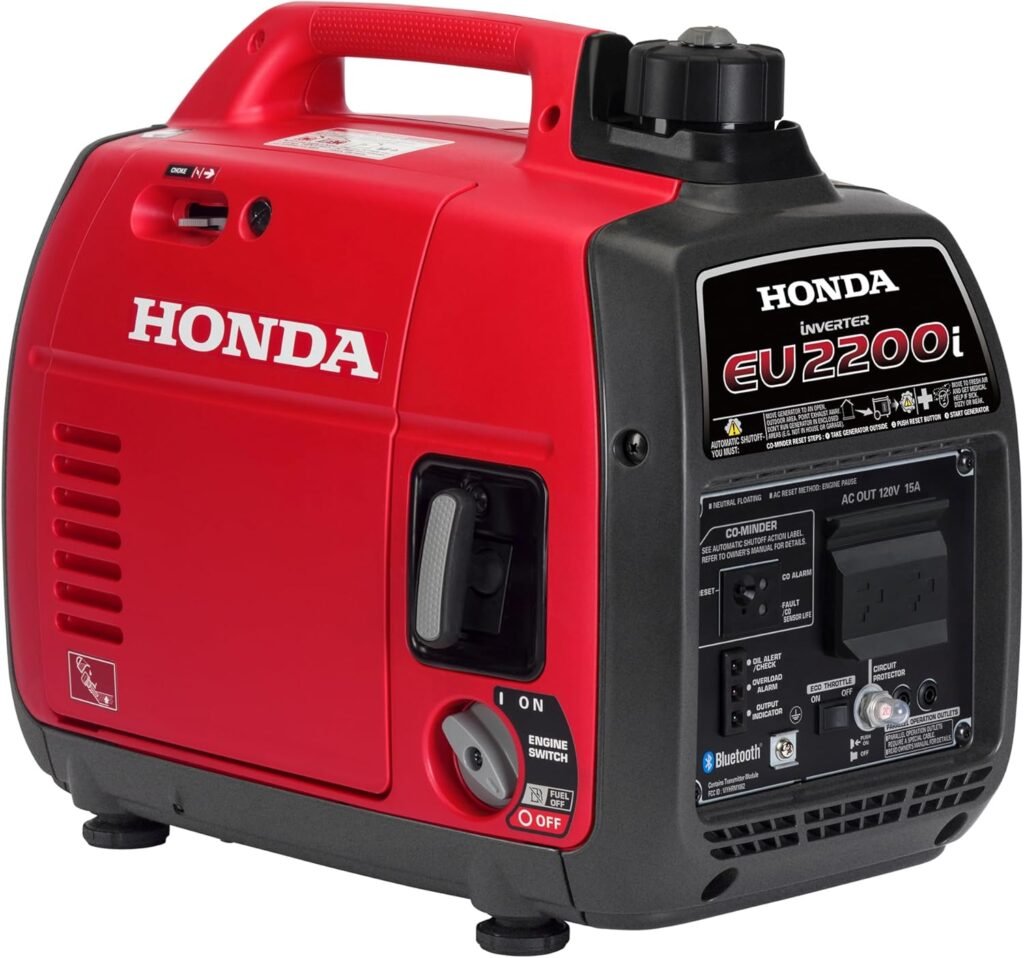
Best quiet generators at a glance
We ranked these generators by the jobs they suit, using published specs for output, weight, fuel, and noise where available. The sound numbers come from manufacturer materials and were measured under different conditions. Use them to understand each model, especially how a Honda changes between light and heavy loads.
| Rank and model | Best for | Running / max watts | Weight |
|---|---|---|---|
| 1. Honda EU2200i | Light loads where noise matters | 1,800 / 2,200W | 47.4 lb dry |
| 2. WEN 56235i | Frequent loading and unloading | 1,900 / 2,350W | 39 lb |
| 3. Champion 4500 Dual Fuel (201319) | RV use and larger 120V loads | 3,500 / 4,500W on gas; 3,150 / 4,500W on propane | 103.6 lb |
1. Honda EU2200i — Best for quiet, light-duty power
The Honda is the model I’d look at first for a fridge during an outage or a fan, lights, and chargers at camp. Honda lists 48 dB(A) at quarter load and 57 dB(A) at rated load. That spread matters if you’re picturing the generator running all evening. A fan and a few chargers give the engine an easier job than a microwave.
The same pattern shows up in fuel use. On its 0.95-gallon tank, Honda lists 8.1 hours at quarter load and 3.2 hours at rated load. If you’re planning a full evening of backup, use those as two reference points. The load changes as appliances cycle, so your actual refueling schedule can land somewhere in between.
Why it ranks first
Honda publishes noise and runtime at two useful loads, and the 47.4-pound dry weight is manageable for many buyers who need to move a generator regularly.
Where it falls short
The standard model supplies 120V with 1,800W of rated output. An RV air conditioner or a combination of kitchen appliances can exceed its limits, especially at startup.
See the full output and runtime figures in Honda’s EU2200i specifications.
Check price and availability on Amazon2. WEN 56235i — Best lightweight option
The 39-pound WEN saves about eight pounds compared with the Honda. That’s worth considering if every trip starts with lifting the generator into a truck or pulling it out of a storage compartment. Its 1,900 running watts and 2,350 starting watts put it in the same general class as the Honda, with a little more room on paper.
Pick it for small plug-in loads and occasional backup. Before buying, check the exact model number, what the seller includes, and how you’d get parts or service. WEN sells several similarly named generators, so specs and features can change between listings. The WEN 56235i manual lists the ratings for this specific model.
3. Champion 4500 Dual Fuel — Best for bigger 120V loads
The Champion 201319 makes more sense when a small generator leaves you juggling appliances. Its 3,500 running watts on gasoline give you more room for an RV or several household essentials. Running output drops to 3,150W on propane, so size your loads for the fuel you plan to use. Check your RV air conditioner’s startup needs and the generator outlet before buying.
Champion lists 61 dB(A) and the manual puts the unit at about 104 pounds. The extra weight matters when you have to lift it into a vehicle. I’d choose it for the higher output and fuel flexibility, especially if it can stay near its storage spot. See Champion’s 201319 product details for the exact model.
How to choose a quiet generator that fits your setup
Compare noise at the load you’ll actually run
A low sound rating usually tells you how a generator behaves with a modest load. Look for the load and distance used for the measurement before comparing two numbers. Think about when sound matters most to you. If your campsite use is mostly lights and a fan, light-load noise is useful. If you’ll run an air conditioner for hours, look for figures closer to that workload. Check campground generator hours and rules before you travel.
Count running watts and motor startup separately
Say your fridge draws 150W while running, a fan uses 60W, and lights and Wi-Fi add 40W. That’s 250W once everything is running. If the fridge briefly needs 750W to start, that moment is about 850W with the other loads on. These are example numbers. Use your own appliance labels or manuals, especially for pumps, compressors, and RV air conditioners.
Pay attention to what might start while something else is already running. A 1,200W cooking appliance added to that 850W startup moment would bring the total to roughly 2,050W. It may be easier to schedule cooking separately than to carry a larger generator on every trip.
Decide how much you’ll move it and how you’ll refuel
Picture moving the generator from storage to its outdoor operating spot. A lighter model helps when the route includes steps or a truck bed. For home backup, think about how long you need to run between refueling stops and which fuel you’ll have on hand. Compare runtime at similar loads and check tank sizes before drawing a conclusion from an advertised maximum.
Plan a safe outdoor spot first
Fuel-burning generators produce deadly carbon monoxide. Run them outdoors at least 20 feet from the home, with exhaust pointed away and the unit well away from doors, windows, and vents. Keep working CO alarms in the home. Never run a generator in a garage or shed or plug it into a wall outlet to power house wiring. See the CPSC carbon monoxide safety guide.
Quiet generator FAQs
Can a 2,200W generator run a refrigerator and freezer?
Often, if their combined running draw and compressor startup demand fit the generator and outlet ratings. The Honda’s 2,200W figure is its maximum, and its rated output is 1,800W. Check what happens if both compressors start while other appliances are already running.
What should I choose if engine noise is the biggest issue?
For Wi-Fi, a fan, lights, and other modest loads, a battery power station avoids engine noise, though its cooling fan may still run. You’ll need enough battery capacity to last until your next recharge. See our portable power station roundup for options.
Can these generators run a 240V appliance?
The specific models in this guide provide 120V output. If your appliance requires 240V, shop for a model that explicitly supports 240V and meets the appliance’s running and starting requirements.
Final verdict
Start with the Honda EU2200i if you’ll mostly run light loads and want published noise figures at both ends of its range. Choose the WEN if you’ll lift the generator often. Step up to the Champion if your RV or backup setup needs more running watts or you want to use propane. Write down what you’ll run together before you buy.
View the Amazon listing