
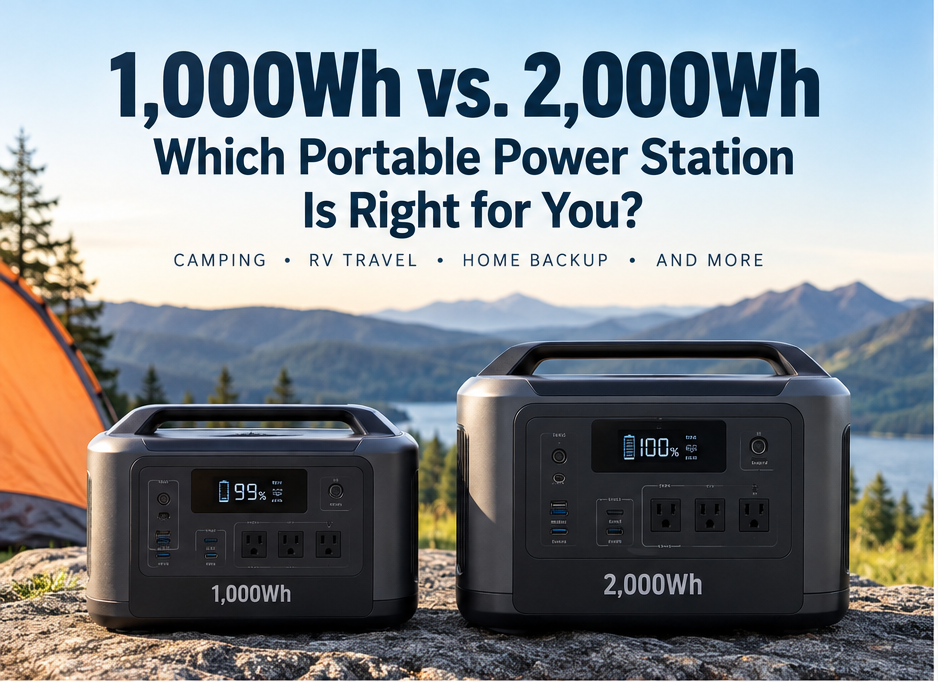
1,000Wh vs 2,000Wh Power Stations: Which Size Do You Really Need?
Portable Power Size Guide
1,000Wh vs. 2,000Wh Power Stations: Which Size Do You Need?
Choose around 1,000Wh for lighter loads and easier transport. Choose around 2,000Wh when your planned backup time requires more stored energy. With the same load and similar efficiency, doubling capacity roughly doubles runtime.
Either size may run a refrigerator if its inverter can handle the running power and compressor startup demand. A larger battery does not automatically mean a more powerful inverter.
Start with the devices you need most, how many hours you want to run them, and when you can recharge. That gives you a better buying target than battery size alone.
Watt-Hours vs. Watts: Two Different Limits
Watt-hours (Wh) measure stored energy. Watts (W) measure power at a moment in time. Think of Wh as the size of a fuel tank and the inverter’s watt rating as the load it can supply.
- Capacity: Helps determine how long your devices can run.
- Continuous AC output: Must cover the devices operating together.
- Startup capability: Must support brief demands from motors and compressors. Check the manufacturer’s limits and supported surge duration.
What Changes When You Double Capacity?
Around 1,000Wh
A useful starting point for electronics, shorter backup periods, and trips where carrying the unit matters.
- Phones, lights, cameras, and laptop charging
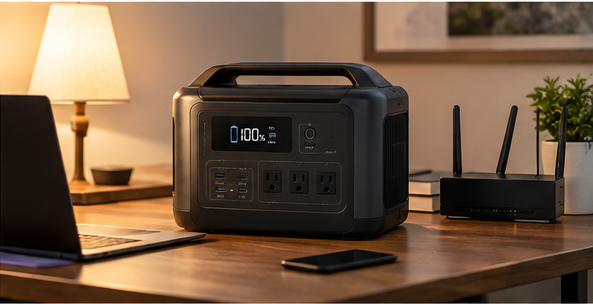
- A measured home-office load for part of a day
- Selected appliances when output ratings permit
- Often lighter than a comparable 2,000Wh model; check actual weight
Around 2,000Wh
More stored energy for longer backup periods or several essential devices sharing the battery.
- More refrigerator backup time under the same conditions
- Longer office or communication backup
- More reserve between opportunities to recharge
- Usually more weight and space to account for
These are approximate capacity classes. Compare each model’s actual Wh rating, output, charging specifications, and weight rather than relying on its model name.
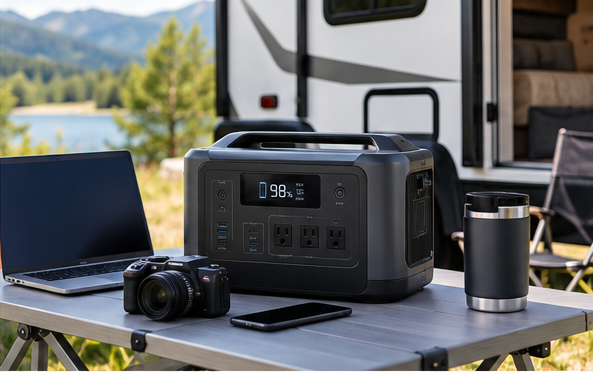
Estimated Runtime: 1,000Wh vs. 2,000Wh
For a simple planning comparison, the table assumes 85% of rated capacity reaches the load: 850Wh from a 1,000Wh battery or 1,700Wh from a 2,000Wh battery. This is an illustrative assumption, not a measured efficiency rating for every station.
Example: 1,000 × 0.85 ÷ 100 = 8.5 hours.
| Example load | Average power | 1,000Wh | 2,000Wh |
|---|---|---|---|
| Laptop drawing a steady 60W | 60W | 14.2 hours | 28.3 hours |
| Combined office equipment | 100W | 8.5 hours | 17 hours |
| Combined essential devices | 200W | 4.3 hours | 8.5 hours |
| Appliance drawing a steady 500W | 500W | 1.7 hours | 3.4 hours |
| Heater on continuously, if output permits | 1,500W | 34 minutes | 68 minutes |
Actual runtime depends on inverter overhead, output type, battery condition, temperature, cutoff settings, and changing device demand. A flat 85% assumption can overestimate runtime for very small AC loads because the inverter itself consumes power. Test your own setup before relying on these figures.
Work Out Your Capacity in Three Steps
- Add the average loads. For example: laptop 60W + router 15W + LED light 10W = 85W. These are hypothetical loads; measure yours.
- Multiply by the hours needed. An 85W load for eight hours needs 680Wh delivered to the devices.
- Allow for losses. At the illustrative 85% usable-energy assumption, 680 ÷ 0.85 = 800Wh of rated capacity.
A 1,000Wh station could fit that example on paper. At 16 hours, the same load needs about 1,600Wh of rated capacity under the same assumption, making a 2,000Wh class station a more suitable starting point. Allow additional reserve for uncertain demand and battery aging.
Separately check the simultaneous wattage and startup requirements. Passing the energy calculation does not establish that the inverter can run every device.
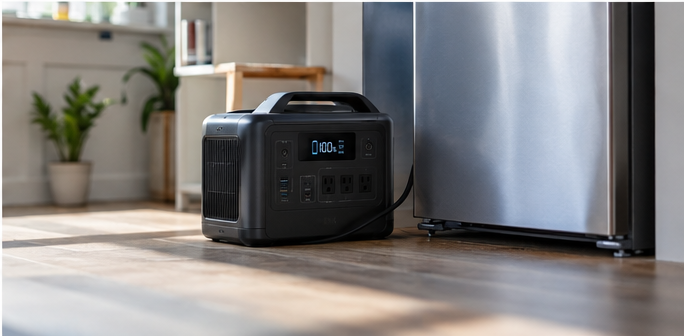
Can Either Size Run a Refrigerator?
Yes, potentially. Check output compatibility first, then estimate runtime from energy use. A refrigerator cycles on and off, so its running wattage alone is not its average consumption across a full day.
Hypothetical example: If a refrigerator uses 1.2kWh over 24 hours, that is 1,200Wh per day, or an average of 50W. Under the 85% assumption, the calculation gives about 17 hours from 1,000Wh or 34 hours from 2,000Wh.
Those are planning estimates, not promises for your refrigerator. Inverter overhead, room temperature, door openings, defrost cycles, and compressor starts can change the result. Use a suitable plug-in energy meter over a representative period and test the station with your appliance.
Recharging Matters as Much as Capacity
A larger battery helps you go longer between charges, but compare how you will refill it. A 2,000Wh model with a higher charging input might recharge faster than a 1,000Wh model with a slower input.
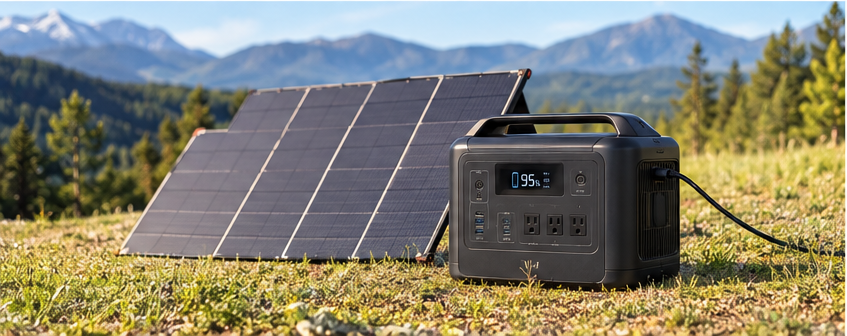
Solar example: At a sustained 200W actually reaching the battery, replacing 1,000Wh takes five hours in an ideal calculation; replacing 2,000Wh takes ten. Real charging takes longer when sunlight varies, losses occur, or charging slows near full. Panel nameplate wattage is not guaranteed charging input.
- Check AC recharge time and whether the quoted figure is 0–80% or 0–100%.
- For solar, confirm the permitted voltage range, maximum open-circuit voltage, current, input power, polarity, and connectors in the station’s manual.
- Compare car-charging input separately; do not assume it matches wall-charging speed.
Before You Buy: A Short Checklist
- Energy: Does capacity cover your measured load and desired hours with reserve?
- Output: Are continuous power and startup capability sufficient?
- Carry weight: Can you comfortably lift the actual model into your vehicle?
- Connections: Are there enough suitable AC, USB, and DC outputs?
- Battery and warranty: Compare chemistry, cycle-life conditions, warranty terms, and service support.
- Practical operation: Check fan noise, storage temperatures, low-load shutoff, and backup transfer behavior if uninterrupted operation matters.
Frequently Asked Questions
Will 2,000Wh give exactly twice the runtime?
Roughly twice at the same load with similar usable capacity and efficiency. Different inverters, settings, and battery conditions can change the ratio.
Does 2,000Wh mean 2,000W of output?
No. Wh measures energy; W measures power. Check the separate continuous AC output rating and startup limits.
Is 1,000Wh enough for a camping weekend?
It depends on total energy use and charging opportunities. Add each device’s watts multiplied by hours used across the whole trip, then allow for losses and reserve. Cooking appliances can change the calculation substantially.
Is 2,000Wh enough for a full day at home?
It may support selected essentials, but it is not a guarantee of whole-home backup. A steady 200W combined load gives about 8.5 hours under this guide’s 85% assumption. Measure your essential loads and plan how to recharge.
Should I buy an expandable power station?
If future needs may grow, check which extra batteries the model supports, their cost, and whether expansion changes charging or output limits. Adding battery capacity does not necessarily increase inverter output.
Compare Your Options
Once you know your target capacity and output needs, compare models and features in these related guides.
Compare Anker vs. Jackery Explore the EcoFlow vs. BLUETTI GuideWhich Capacity Fits Your Plan?
Start with 1,000Wh when your calculated energy needs fit within its usable capacity and carrying it comfortably is a priority.
Move toward 2,000Wh when you need longer runtime, more shared energy, or more reserve between charges. Confirm output compatibility separately for either size.
Measure first, allow for losses, and compare actual specifications. That helps you buy enough backup without carrying more battery than you need.
About These Estimates
This is a capacity-planning guide, not a hands-on test of specific power stations. All runtime examples are calculations using stated assumptions. Consult the manual for your model and verify performance with your own devices.
Manufacturer references: EcoFlow’s refrigerator power guide and Jackery’s solar-panel compatibility guidance.