
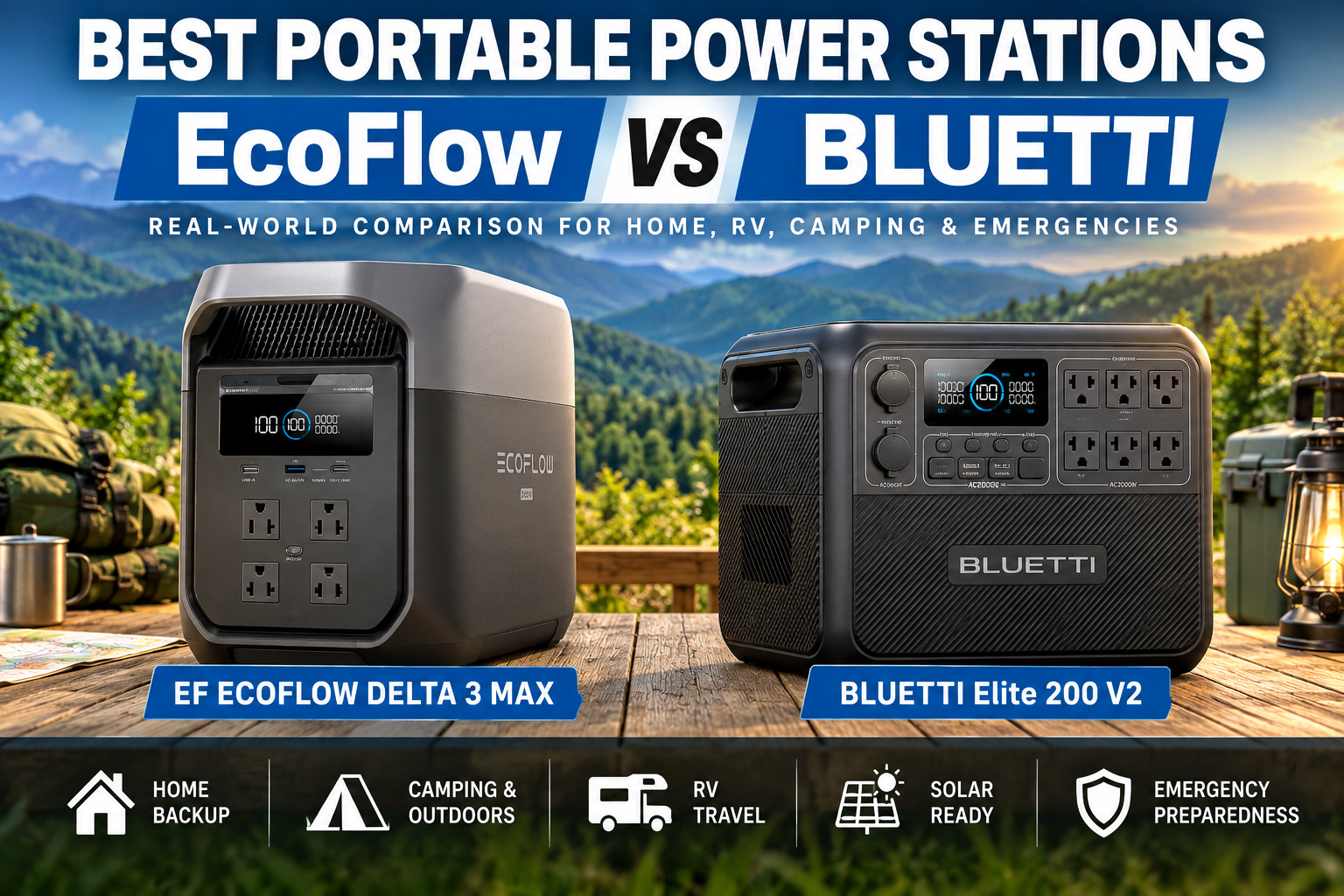
EcoFlow vs BLUETTI: DELTA 3 Max vs Elite 200 V2
EcoFlow DELTA 3 Max vs. BLUETTI Elite 200 V2: Which Should You Choose?
Two portable power stations with around 2,000Wh of battery capacity—but which features matter for your needs?
The EcoFlow DELTA 3 Max and BLUETTI Elite 200 V2 are options for powering household essentials, camping gear, and electronics. Choosing between them means looking beyond brand names to compare output, charging limits, portability, and the equipment included in your purchase.
This comparison covers the standard DELTA 3 Max, not the DELTA 3 Max Plus. We compare it with the Elite 200 V2 to help you understand the differences before buying.
How this comparison was prepared: This is a research-based comparison, not a hands-on test. The capacity, output, and charging specifications discussed here come from published manufacturer information. Actual runtime and charging performance vary with the equipment, settings, and operating conditions.
Affiliate disclosure: This article contains affiliate links. If you buy through them, PowerStationReviews.com may earn a commission at no additional cost to you.
EcoFlow vs. BLUETTI at a Glance
These models have similar battery capacity. Start with their rated output, then compare charging options, portability, and the current package price.
EcoFlow DELTA 3 Max
A roughly 2kWh power station to consider when your appliances fit within its output and startup limits. Compare its charging options and features with the BLUETTI before deciding.
Explore the EcoFlow DetailsBLUETTI Elite 200 V2
Offers 200W more rated continuous AC output than the DELTA 3 Max. Its battery capacity is only about 1.3% larger, so that difference alone should not determine your choice.
Explore the BLUETTI DetailsSpecifications are manufacturer ratings, not results from our own testing. Usable battery energy and runtime depend on the connected devices and operating conditions.
EcoFlow DELTA 3 Max Review

The standard EcoFlow DELTA 3 Max combines a 2,048Wh battery with 2,400W of rated continuous AC output. Consider it for household essentials or camping equipment when their running power and startup requirements fit the unit’s limits.
- Battery capacity: 2,048Wh of rated energy storage. Usable energy delivered to appliances will be lower because of conversion losses and the unit’s own consumption.
- Continuous AC output: 2,400W total. Add together the running watts of devices you plan to use at the same time.
- AC charging: EcoFlow advertises 0–80% in 68 minutes under its stated test conditions. This is not a charging time we measured ourselves.
- Solar charging: Supported with compatible equipment. Check panel voltage, current, and connection requirements before purchasing panels.
Before choosing: This is the DELTA 3 Max, not the Max Plus. Check the exact model and bundle carefully. Battery capacity alone does not tell you whether it can start an appliance or how long it will run.
Specification source: EcoFlow DELTA 3 Max manufacturer information .
View EcoFlow Price & Customer ReviewsBLUETTI Elite 200 V2 Review

The BLUETTI Elite 200 V2 has a 2,073.6Wh battery and 2,600W of rated continuous AC output. Its battery is close in size to the DELTA 3 Max, while its continuous output rating is 200W higher.
- Battery capacity: 2,073.6Wh—about 1.3% more rated capacity than the EcoFlow. That small difference alone is unlikely to decide which model fits your needs.
- Continuous AC output: 2,600W total. Check both running demand and startup requirements for your appliances.
- Fast charging: BLUETTI advertises reaching 80% in approximately 1.1 hours using TurboBoost charging under its stated conditions. This is a manufacturer claim, not our own test result.
- Solar charging: Supported with compatible panels. Actual charging depends on the panel setup, sunlight, and the power station’s input limits.
Power Lifting explained: The advertised 3,900W Power Lifting mode is intended for compatible resistive loads. It is not a 3,900W continuous AC output rating and should not be used as the general limit for electronics or motor-driven appliances. Follow the manufacturer’s instructions.
Specification source: BLUETTI Elite 200 V2 manufacturer information .
View BLUETTI Price & Customer ReviewsEcoFlow DELTA 3 Max vs. BLUETTI Elite 200 V2
These power stations have similar rated battery capacity. BLUETTI offers 200W more continuous AC output, while both manufacturers advertise charging to 80% in roughly an hour. Compare the specifications below with your actual power needs.
On smaller screens, scroll sideways to view the full table.
| Feature | EcoFlow DELTA 3 Max | BLUETTI Elite 200 V2 |
|---|---|---|
| Rated battery capacity | 2,048Wh | 2,073.6Wh |
| Continuous AC output | 2,400W total | 2,600W total |
| Advertised charging to 80% | 0–80% in 68 minutes with AC charging | Approximately 1.1 hours using TurboBoost charging |
| Special appliance mode | X-Boost: advertised support for compatible appliances rated up to 3,400W | Power Lifting: advertised support for compatible resistive loads rated up to 3,900W |
| Solar charging | Supported with panels that meet the model’s input and connection requirements | Supported with panels that meet the model’s input and connection requirements |
| Solar panels included? | Depends on the selected bundle | Depends on the selected bundle |
| Main comparison point | Check whether its output, charging options, and package price fit your needs | Higher continuous output; only about 1.3% more rated battery capacity |
Charging figures: These are manufacturer claims under their stated conditions, not results from our own testing. Settings, battery temperature, and available input power can affect charging time.
Special modes: X-Boost and Power Lifting do not increase the continuous AC output ratings shown above. Check appliance compatibility and the manufacturer’s instructions before using either mode.
Runtime: Rated battery capacity is not the same as usable energy at the outlets. Conversion losses, operating settings, and appliance usage affect actual runtime.
Sources: EcoFlow DELTA 3 Max specifications and BLUETTI Elite 200 V2 specifications .
EcoFlow or BLUETTI: Which Should You Choose?
Start with the appliances you need to run and your planned charging setup. Both models offer roughly 2kWh of rated battery capacity and fast AC charging, so those features alone do not establish a clear winner.
Consider the EcoFlow DELTA 3 Max If:
- Its 2,400W continuous AC output and startup capability meet your equipment’s requirements.
- Its charging connections and input limits suit the equipment you plan to use.
- The exact package offers a better purchase price or more useful accessories for your setup.
Check that the listing is for the standard DELTA 3 Max. Features advertised for the Max Plus should not be assumed to apply.
Consider the BLUETTI Elite 200 V2 If:
- You need the additional continuous output: 2,600W compared with the EcoFlow’s 2,400W.
- Your combined running load exceeds 2,400W but stays within 2,600W, and startup demands also fit the BLUETTI’s limits.
- Its current price, compatible charging equipment, and included accessories offer the better package for your needs.
Its battery capacity is only about 1.3% larger. That small difference does not establish a meaningful runtime advantage without comparable testing.
Our Research-Based Recommendation
BLUETTI has the advantage in rated continuous AC output. That may matter if your equipment needs more than 2,400W. If your loads fit within both models’ limits, compare the complete package cost, charging compatibility, weight, warranty terms, and return policy.
We would not choose EcoFlow solely for faster AC charging: the advertised times to 80% are similar. We also would not pay extra for BLUETTI solely for its small increase in rated battery capacity.
Before buying, check your appliances’ running and startup requirements. Neither battery capacity nor a special appliance mode guarantees that a particular device will run successfully.
EcoFlow vs. BLUETTI FAQs
Is the EcoFlow DELTA 3 Max better than the BLUETTI Elite 200 V2?
Neither is the better choice for every buyer. The Elite 200 V2 has higher rated continuous AC output: 2,600W versus 2,400W. Their battery capacities and advertised charging times are similar. Compare appliance compatibility, charging options, portability, and the current price of equivalent packages.
Which power station has the larger battery?
The BLUETTI Elite 200 V2 has 2,073.6Wh of rated capacity, compared with 2,048Wh for the EcoFlow DELTA 3 Max. That is a difference of 25.6Wh, or about 1.3%. It does not establish a meaningful runtime advantage without comparable testing.
Which model charges faster from a wall outlet?
The published figures are close. EcoFlow advertises 0–80% in 68 minutes, while BLUETTI advertises reaching 80% in approximately 1.1 hours using TurboBoost charging. These manufacturer claims are not a controlled head-to-head test. Temperature, settings, and available input power can affect actual charging time.
Can either power station run a refrigerator?
Either may be suitable when its continuous output and startup capability meet the refrigerator’s requirements. Runtime depends on usable battery energy, compressor cycling, room temperature, and other connected devices. Measure the refrigerator’s energy use over time for a more useful estimate than its running wattage alone.
Can both models charge from solar panels?
Yes, with compatible panels and connections. Check the power station’s permitted input voltage, current, and wattage before connecting a panel setup. Actual solar charging varies with sunlight, shading, temperature, and panel placement.
Are solar panels included with either model?
That depends on the package you select. Both products may be offered as standalone power stations or in bundles with accessories. Read the selected listing’s included-equipment details rather than relying on the product photo.
Which is better for camping or RV use?
Compare the appliances you need to run, available storage space, carrying weight, and your charging setup. BLUETTI’s higher continuous output may help with some loads, but its small capacity increase alone is not a strong reason to choose it. Check outlet types and appliance startup requirements before planning an RV setup.
Are X-Boost and Power Lifting continuous output ratings?
No. These are special operating modes with appliance compatibility limits. They do not change the models’ rated continuous AC outputs of 2,400W for EcoFlow and 2,600W for BLUETTI. BLUETTI specifies compatible resistive loads for Power Lifting. Follow each manufacturer’s instructions before using these modes.
Compare the Packages Before You Buy
Both models offer roughly 2kWh of rated battery capacity. Check that your appliances fit the output limits, then compare the current prices, included equipment, seller, and purchase terms.
EcoFlow DELTA 3 Max
Consider this model when its output and charging options meet your needs. Confirm that the selected listing is for the standard DELTA 3 Max and check which accessories are included.
View EcoFlow Price & Customer ReviewsBLUETTI Elite 200 V2
Consider this model if its additional 200W of continuous output matters for your equipment. Compare the complete package price rather than assuming its slightly larger battery offers better value.
View BLUETTI Price & Customer ReviewsCheck the bundle: Solar panels and other accessories are included only when specified in the selected listing.
EcoFlow vs. BLUETTI: Which Is the Better Buy?
The EcoFlow DELTA 3 Max and BLUETTI Elite 200 V2 offer similar rated battery capacity and advertised AC charging times. The clearest difference covered here is continuous AC output: 2,400W for EcoFlow and 2,600W for BLUETTI.
Consider BLUETTI if that additional output matters for your appliances. If your equipment fits within both models’ operating limits, compare charging compatibility, carrying weight, included accessories, and the complete purchase price.
Neither model earns an automatic value advantage. A lower price is useful only when the exact model and package meet your needs. Check startup demands, warranty coverage, seller details, and return terms before ordering.
This research-based comparison uses published specifications rather than our own hands-on testing. Manufacturer ratings help narrow your options; actual runtime and charging results depend on your equipment and operating conditions.
Need help choosing a battery size? Read our 1,000Wh vs. 2,000Wh power station guide .