
Solar Generator vs. Gas Generator: Which Backup Power Option Is Right for You?
Solar Generator vs. Gas Generator: Which Backup Power Option Is Right for You?
Compare fuel, noise, maintenance, runtime, power output, safety, and everyday use before choosing your backup power system.
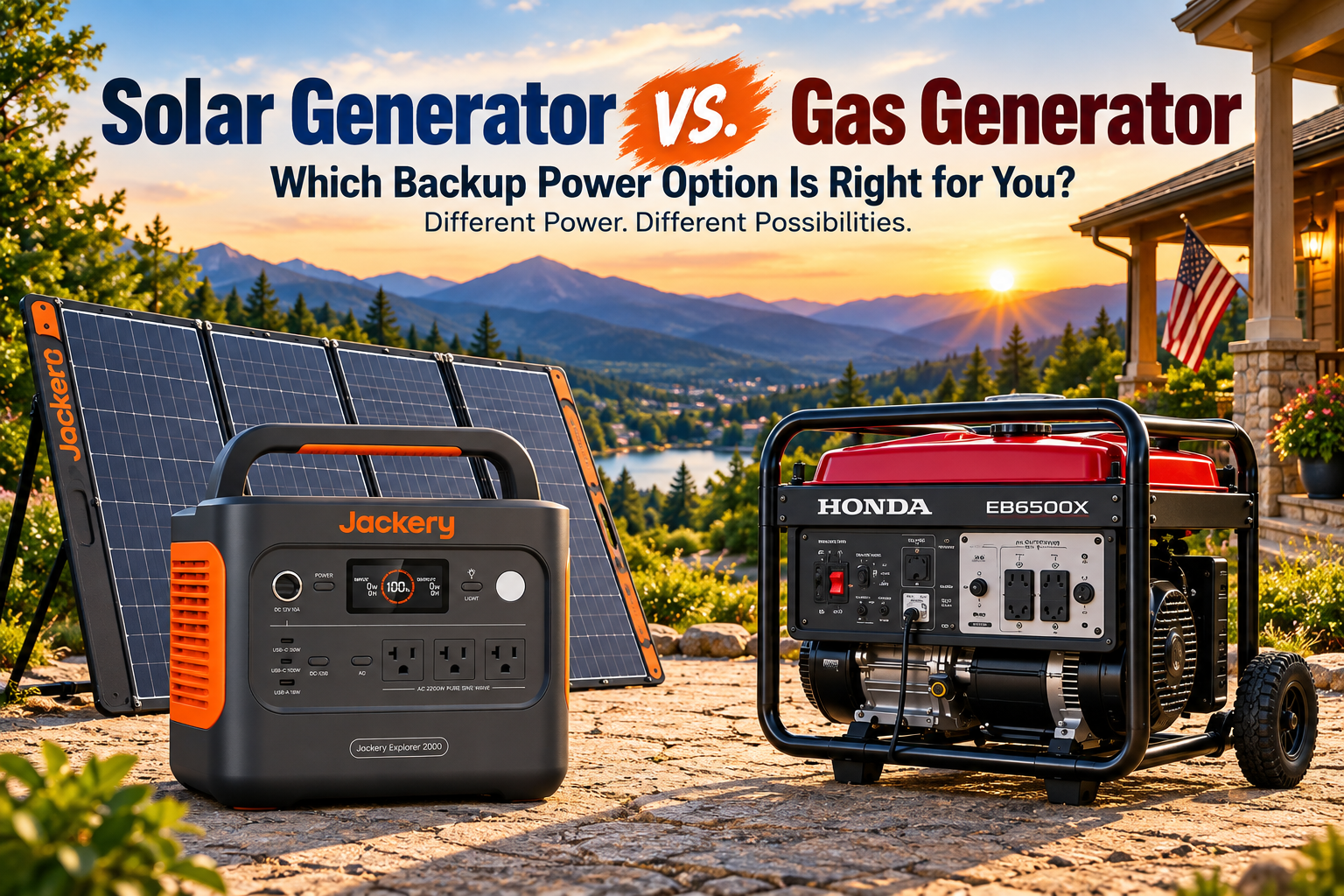
Solar Generator vs. Gas Generator at a Glance
| Feature | Solar Generator | Gas Generator |
|---|---|---|
| Power source | Rechargeable battery charged by solar, wall power, or a vehicle | Gasoline or another approved fuel, depending on the model |
| Noise | Very quiet during battery operation | Engine noise while running |
| Exhaust | No combustion exhaust | Combustion exhaust and carbon monoxide |
| Runtime | Depends on battery capacity, load, and available recharging | Depends on fuel supply, load, and generator efficiency |
| Refueling / charging | Solar, wall outlet, or vehicle charging depending on model | Requires fuel |
| Maintenance | Generally low compared with an engine generator | Requires regular engine and fuel-system maintenance |
| Indoor use | Many battery power stations can be used indoors when operated according to their manuals | Portable fuel-burning generators should never be operated indoors or in enclosed spaces |
| Portability | Often easier to move, although larger battery units can be heavy | Portable models vary, with many requiring wheels or handles |
| Best suited for | Quiet backup, electronics, appliances, camping, RV use, and everyday emergency power | High-demand equipment, longer outages, and situations where rapid refueling is important |
What Is a Solar Generator?
Despite the name, a modern solar generator is generally a portable battery power station paired with an inverter and charging system. It stores electricity in a battery and can often be recharged from solar panels, a wall outlet, or a vehicle.
Because there is no combustion engine running during battery operation, a solar generator is quiet and does not produce engine exhaust. That makes this type of backup power especially useful for electronics, refrigerators, lighting, internet equipment, camping, RVs, and other lower-to-moderate power needs.
Where Solar Generators Shine
- Quiet operation
- No gasoline required during battery operation
- Rechargeable from solar panels
- Low routine maintenance compared with engine generators
- Useful for home backup, camping, RVs, and electronics
What to Watch
- Battery capacity limits runtime
- Large appliances can drain batteries quickly
- Solar charging depends on available sunlight and equipment
- Large-capacity units can be heavy
What Is a Gas Generator?
A gas generator uses an internal-combustion engine to produce electricity. Instead of storing a fixed amount of electrical energy in a battery, it can continue generating electricity as long as it has an adequate fuel supply and is operated within its rated limits.
That makes gas generators useful when higher continuous power is needed or when an outage could last for a long time. They are also common for tools, construction work, larger appliances, and emergency backup.
Where Gas Generators Shine
- High power output is available on many models
- Runtime can be extended by adding fuel
- Useful for larger appliances and high-demand equipment
- Can be practical during extended outages
The Biggest Differences Between Solar and Gas
Which Is Better for a Power Outage?
There is no single answer because outages are different. A short outage may require only a refrigerator, lights, Wi-Fi, and a few electronics. A longer outage may require substantially more energy or higher continuous output.
| Situation | Solar Generator | Gas Generator |
|---|---|---|
| Short outage | Convenient for essential electronics and appliances within the unit’s limits | Works well, but requires outdoor operation and fuel |
| Overnight outage | Useful when battery capacity covers the expected load | Can continue operating with fuel, subject to safe operation and maintenance |
| Multi-day outage | Solar panels can help replenish the battery during suitable conditions | Fuel availability becomes an important consideration |
| High-demand equipment | Requires a unit with sufficient inverter output and battery capacity | Many models are designed for higher continuous loads |
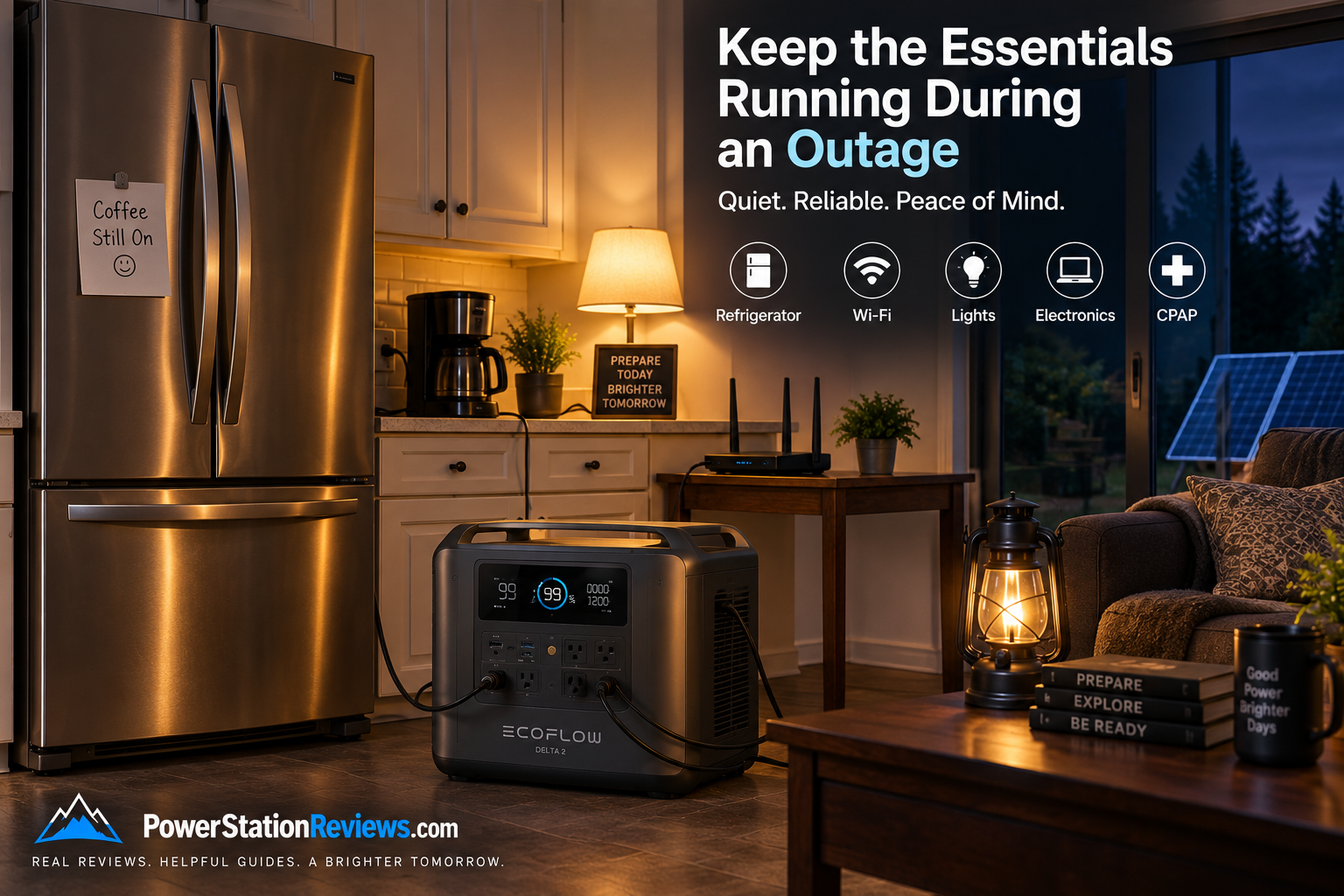
What Can Each Type Power?
Actual performance depends on the specific model, appliance wattage, startup surge, battery capacity, generator output, and how long you need the equipment to run.
| Device | Solar Generator | Gas Generator |
|---|---|---|
| Refrigerator | Often, if the inverter and battery are appropriately sized | Yes, when the generator is properly sized |
| Freezer | Often, with adequate battery capacity | Yes, when properly sized |
| Wi-Fi Router | Excellent fit for battery backup | Yes |
| Television | Yes | Yes |
| LED Lights | Yes | Yes |
| CPAP Machine | Often a strong use case for battery backup | Yes, with safe outdoor generator setup and appropriate connection |
| Microwave | Possible with sufficient inverter output | Often possible with sufficient generator output |
| Space Heater | Usually a difficult load for smaller battery systems because of high continuous wattage | Often possible with an appropriately sized generator |
| Well Pump | Requires careful sizing for starting and running loads | Requires careful sizing for starting and running loads |
Important Gas Generator Safety
Never operate a portable gas generator inside a home, garage, basement, crawlspace, shed, or other enclosed area.
Portable generators should be operated outdoors and away from the home, with exhaust directed away from windows, doors, and vents. Opening a door or window does not make indoor generator operation safe.
Always follow the generator manufacturer’s instructions and use working carbon-monoxide alarms in the home.
Can You Have Both?
Absolutely. A solar generator and a gas generator do not necessarily have to compete with each other. Some homeowners use a battery power station for quiet everyday backup and a gas generator when a longer outage or higher power demand makes additional generation useful.
A Two-Layer Backup Strategy
Use battery power for quiet nighttime operation, electronics, internet equipment, lighting, and other essential loads. Keep a properly maintained fuel generator available for situations that require more continuous power or longer runtime.
Which Type Makes Sense for You?
How Much Battery Capacity Do You Need?
If you’re leaning toward a solar generator, our guide comparing 1,000Wh and 2,000Wh systems explains why battery capacity matters and how the difference affects real-world backup use.
1,000Wh vs. 2,000Wh Power Stations See how capacity affects runtime and everyday backup use →Related Portable Power Guides
Solar Generator vs. Gas Generator FAQ
Can a solar generator replace a gas generator?
Sometimes. A sufficiently powerful battery system can handle many household essentials, but the right choice depends on your required wattage, battery capacity, runtime, and ability to recharge.
Can a solar generator run a refrigerator?
Many can, provided the inverter can handle the refrigerator’s startup demand and the battery has enough capacity for the desired runtime.
How long can a gas generator run?
Runtime varies by generator, load, fuel capacity, and operating conditions. Unlike a battery system, runtime can generally be extended by safely refueling the generator according to the manufacturer’s instructions.
Can you use a gas generator inside a garage?
No. Portable gas generators should never be operated inside a garage or other enclosed area because of the risk of carbon monoxide buildup.
Is a solar generator completely maintenance-free?
No. Battery power stations still need to be stored, charged, inspected, and maintained according to the manufacturer’s instructions. They simply avoid many of the routine mechanical tasks associated with combustion engines.
Still Deciding What Size Power Station You Need?
Use the PowerStationReviews homepage calculator and explore our portable power guides before choosing your backup setup.
Explore PowerStationReviews →Final Takeaway
Solar generators and gas generators are both useful backup-power tools, but they approach the problem differently. Solar generators offer quiet battery power, rechargeable energy storage, and no combustion exhaust during operation. Gas generators can deliver substantial continuous power and extend runtime with additional fuel.
The best starting point is not the generator itself. Start with your actual needs: What do you need to power? How many watts does it require? How long do you need it running? And how will you recharge or refuel?
Once you answer those questions, the choice between battery-based and fuel-based backup power becomes much easier to understand.
Disclosure:PowerStationReviews may earn a commission from qualifying purchases made through some links on this website. This does not change the price you pay.